Commercial Gas Wok Cooker Troubleshooting Guide

A wok range asks more of its gas supply than anything else in a commercial kitchen. The burners are high output by design — that ferocious heat is the whole point — and everything that follows from that shapes how they fail.
Two consequences matter for troubleshooting. First, wok ranges cook with a lot of oil at high heat, so grease reaches the jets and pilots faster than on other equipment. Second, because the gas rate is high, a supply or pressure problem shows up here first, often while the rest of the kitchen still seems fine.
For the parts, see all gas equipment parts.
Why is my wok burner not getting hot enough?
Start by counting how many burners are affected. It splits the diagnosis immediately and costs nothing.
| What you see | Where the fault is |
|---|---|
| One burner weak, the others fine | That burner — blocked ports or a worn jet |
| All wok burners weak | Gas supply or pressure to the appliance |
| All wok burners weak and other appliances weak | Kitchen supply or the meter — not the wok range at all |
| Weak only when everything else is running | Supply can't meet total demand — pressure drops under load |
That last row is the one people miss. A wok range can perform perfectly at 10am and badly at 7pm purely because the supply is being shared with a full kitchen. If your wok burner is only disappointing during peak service, the appliance may be fine and the installation undersized. That needs an engineer with a manometer, not a new part.
For a single weak burner, it is nearly always the jet or the ports. Grease and carbon restrict them, and a jet that has eroded, corroded or been drilled out at some point delivers the wrong gas rate permanently — those need replacing rather than cleaning.
Why does my wok range pilot keep going out?
Grease first, parts second. Wok pilots clog faster than any other pilot in the kitchen.
The chain is the same as every gas appliance: the pilot flame heats the thermocouple, which generates roughly 25–30 millivolts, which energises an electromagnet inside the gas valve. That magnet is the only thing holding the gas on. Weaken any link and it shuts down.
- Clean the pilot burner and its orifice. On a wok range this is the first move, not the last. The orifice is tiny and it sits in an oil-laden airstream all service.
- Look at the pilot flame. Crisp blue and wrapping the thermocouple tip is healthy. Small, yellow or lazy means it isn't heating the tip.
- Check the thermocouple tip is in the flame, not beside it — easily knocked during cleaning.
- Hold the knob in for 20–30 seconds. Holds only when you hold it longer? The thermocouple is weakening.
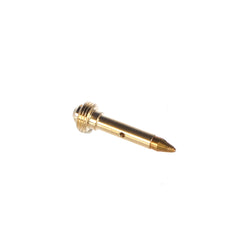
- Adjust the pilot if your range has an adjuster. Many wok ranges have a small brass pilot adjustment screw. Turning it anticlockwise increases the flame, clockwise decreases it. Adjust in small increments and do not remove the screw.
Strong blue pilot, new thermocouple, and it still cuts out? The electromagnet inside the gas control valve has failed — it can no longer hold on the voltage it is being given. On many valves the magnet unit is a separate, much cheaper part than the complete tap.
Which gas valve does a wok burner use?
Wok burners need a tap rated for their gas rate. A standard cooker tap will not deliver what a high-output wok burner needs, so valves for wok ranges are a specific high-output type.
We stock PEL high-output safety taps of the kind fitted to wok burners, alongside standard cooker taps and thermostatic valves — browse gas control valves. To get the right one, quote the type number stamped on the valve body. It is the only reliable way to match it.
Note the distinction while you're identifying yours: a safety tap is on/off with a flame failure device built in, while a thermostatic valve modulates to hold a set temperature. Wok burners use the former.
Why won't my wok burner light at all?
Check the supply before the parts — is the isolation valve fully open, and is other gas equipment working?
Then:
- Pilot won't light — fully blocked pilot orifice, or no gas reaching it
- Pilot lights, dies on releasing the knob — thermocouple
- Pilot fine, main burner won't fire — blocked burner ports, or the tap itself
- Burner lights but only partially around the ring — blocked ports on the dead section
That last one is common on wok burners with a ring or multi-ring burner: half the ring lights, the other half stays dark. It's a cleaning job, not a new burner.
Why is my wok burner flame yellow?
Wok burners should burn blue, and a strong wok burner is loud and blue. Yellow, lazy or lifting flames mean the air-to-gas mixture is wrong, and incomplete combustion produces carbon monoxide.
Causes, in order:
- Grease or debris in the venturi — the most likely cause on this equipment
- Air shutter closed too far, starving the burner of primary air
- Blocked or worn burner jets
- Wrong jet for the gas type after a conversion
- Incorrect supply pressure
Wok ranges are usually working under a heavy extraction canopy, which can mask a combustion problem by pulling the products of combustion away. Do not use "we can't smell anything" as evidence the flame is fine. Judge it on flame colour.
What about water getting into the burners?
Many Chinese wok ranges have a running water tap and a rinse trough behind the wok wells. Water overflowing into the burner area causes problems that look like gas faults:
- Pilots that go out for no apparent reason
- Burners that light unevenly or spit
- Corroded jets and burner castings over time
Keep the drain and trough clear, and check the tap isn't left running harder than necessary. If a burner area is regularly getting wet, fix that before replacing parts — otherwise the new parts go the same way.
What gas pressure should a UK wok range run at?
UK commercial catering appliances are set up around 20 mbar for natural gas and 37 mbar for propane (LPG) — not the inches of water column quoted by American articles. The correct figure and injector marking for your gas type are on the appliance data plate.
Because wok burners run at a high gas rate, correct pressure matters more here than on any other appliance in the kitchen. A supply that is marginal will show up as a disappointing wok burner long before it affects an oven.
Threads are BSP, not the NPT sizes on US parts listings — check before ordering gas pipe fittings. Converting between natural gas and LPG means changing injectors and re-commissioning: Gas Safe work.
How do I keep a wok range reliable?
Manufacturer guidance for this equipment is unusually blunt about it: keep the burners and pilots clean of grease. In practice:
- Clean the pilots and burner ports on a regular schedule, not when something fails
- Keep the water trough and drain clear so nothing floods the burner area
- Clear grease from the venturi as well as the visible burner top
- Keep a spare thermocouple in the correct length and thread on the shelf
- If performance drops gradually across all burners, get the supply pressure checked rather than replacing parts one at a time
Can I repair a commercial wok range myself?
Cleaning and diagnosing are reasonable in-house work: clearing jets and ports, cleaning pilots, adjusting a pilot flame with the adjuster provided, and identifying which part has failed.
Fitting gas parts is not. In the UK, work on commercial catering gas appliances must be carried out by a Gas Safe registered engineer holding the commercial catering qualifications. That covers gas taps, injectors, burners and pilot assemblies. Given the gas rates a wok range runs at, this is not equipment to improvise on. Diagnose it, order the right part, have it fitted and leak-tested.
Frequently asked questions
Why is my wok burner weaker than it used to be?
If it has faded gradually across all burners, suspect gas supply or pressure. If one burner has dropped off, it's that burner's jet or ports. Gradual decline on a single burner is usually grease.
Can I just drill out a blocked jet?
No. Drilling changes the orifice size permanently, which changes the gas rate and the combustion. It is how a blocked jet becomes a dangerous one. Clean it, or replace it with the correct jet.
My wok range is fine in the morning and weak at night — is it broken?
Probably not. That pattern points to supply pressure dropping when the whole kitchen is running. Get the installation checked under full load rather than buying parts.
How do I identify my wok range gas tap?
The type number is stamped on the valve body. Quote that and we can match it exactly. Wok burners need a high-output tap — a standard cooker tap won't deliver the gas rate.
How fast can I get a part?
We hold genuine replacement gas parts in UK stock. Order before 10am for next-day delivery, free over £25. Call 073 8051 5838 with the make, model and the number stamped on the old part.
Need help identifying the part?
Send a photo of the valve body, pilot assembly or data plate and we'll match it.
Shop burner jets · Shop thermocouples · Shop pilot burners · Shop gas control valves · Shop control knobs · All gas equipment parts