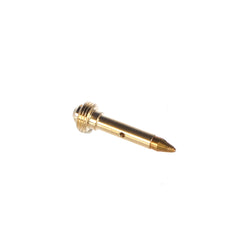
Weak, Yellow or Missing Pilot Flame? How to Fix a Pilot Burner

What does a healthy pilot flame look like?
A good pilot flame is strong, steady and blue, and it wraps firmly around the tip of the thermocouple. It should not flicker, lift away, or burn yellow.
That last part matters more than people realise. The pilot's job is not just to light the main burner — it also has to keep the thermocouple hot enough to hold the gas valve open. A poor pilot flame causes faults that look like a failed thermocouple but are not.
What does a yellow or weak pilot flame mean?
Yellow means incomplete combustion — the flame is not getting the air or the gas flow it needs. In practice, on commercial equipment, that almost always comes down to one thing: the pilot orifice is partially blocked.
Pilot jets are tiny. In a commercial kitchen they sit in an atmosphere of grease vapour, carbon and dust for years. It takes very little build-up to choke the gas flow.
- Weak or short flame — restricted orifice, or low gas pressure.
- Yellow, lazy flame — incomplete combustion; blocked orifice or blocked air opening.
- Flame lifting away from the burner — too much gas velocity through a partly blocked jet, or a damaged burner head.
- Sooting or carbon around the pilot — the flame has been burning badly for a while; clean it and find out why.
- No flame at all — see the section below.
How do I clean a pilot burner?
- Isolate the gas and let the appliance go fully cold.
- Remove the pilot assembly or gain access to the pilot head.
- Clear the orifice. Use compressed air, or carefully pass a fine needle through the jet. Do not enlarge it, and do not use anything that could score it — the size of that hole is what meters the gas.
- Clean carbon and grease from the burner head and its air openings.
- While you are in there, clean the thermocouple tip with fine steel wool — carbon on the tip causes its own set of faults.
- Reassemble, restore gas, and light. The flame should now be blue, steady, and enveloping the thermocouple tip.
Cleaning fixes a large proportion of pilot faults and costs nothing. Always try it before buying parts.
When does the pilot burner need replacing rather than cleaning?
- The burner head is cracked, corroded or distorted by heat.
- The orifice is damaged or enlarged — often from someone poking it out with the wrong tool. An enlarged jet will never give a correct flame again.
- The flame is still poor after a proper clean and your gas supply pressure is correct.
- The thermocouple bracket is broken, so the tip can no longer be held in the flame. This is a very common failure and it cannot be bodged — if the tip is not in the flame, the appliance will keep dropping out.
My pilot won't light at all — is that the pilot burner?
Possibly, but work through the chain in order:
- Is gas reaching the appliance? Check the isolation valve and that other gas appliances work.
- Is there a spark? No spark points at the piezo igniter or ignition lead, not the burner. Piezo igniters are inexpensive and a common failure.
- Spark but no flame? Now suspect a fully blocked pilot orifice — or air in the line after gas work, which can take a few attempts to purge.
- Lights then immediately dies on releasing the knob? That is a thermocouple fault, not a pilot burner fault.
Which pilot burner do I need?
Match these:
| What to check | Why |
|---|---|
| Number of flames | Pilot burners come as single, two-flame or three-flame heads. It must match what your appliance was built with. |
| Type / part number | Stamped on the burner body. This is the fastest way to get an exact match. |
| Orifice size | Meters the gas. Must be correct for the appliance and the gas type. |
| Thermocouple mounting | The bracket must hold the thermocouple tip in the flame, in the right position. |
We stock Polidoro pilot burners — the make fitted to a large share of commercial gas cookers, ranges and fryers — in two-flame and three-flame versions, at £24.99. Stocked types include 100079, 100148, 100972, 104485, 107272 and 107356, covering Falcon and many other commercial gas ranges.
If you can read a part number off the old burner, quote it and you will get an exact match. If not, send a photo.
Browse all pilot burners — 61 parts in UK stock.
How do I fit a pilot burner?
- Isolate the gas. Let it cool.
- Disconnect the pilot gas line, the thermocouple and any ignition lead.
- Unbolt the old pilot assembly, noting its exact orientation before it comes off.
- Fit the new burner in the same orientation and secure it.
- Reconnect the gas line — check for leaks on relighting.
- Seat the thermocouple tip in the flame path, in the bracket, exactly as before. This is the step that decides whether the repair works.
- Reconnect the ignition lead, restore gas, and light. Confirm a strong blue flame wrapping the thermocouple tip.
Gas work must be carried out by a competent person. In the UK, commercial catering gas appliances must be worked on by a Gas Safe registered engineer qualified for commercial catering.
Frequently asked questions
My pilot keeps going out even after a new thermocouple — why?
Because the pilot flame is not heating the thermocouple properly. A new thermocouple cannot fix a starved flame. Clean the pilot orifice and make sure the tip is sitting in the flame. This is the single most common reason a thermocouple replacement "doesn't work".
Can I just drill out a blocked pilot orifice?
No. The orifice size meters the gas flow. Enlarging it gives too much gas, an unstable flame, and unsafe combustion. Clean it, or replace the burner.
Do I need the same brand of pilot burner?
You need the same type — flame count, orifice and mounting. Polidoro pilot burners fit a very wide range of commercial gas equipment, which is why they are the common replacement.
How quickly can I get one?
Pilot burners are held in UK stock. Order before 10am for next-day delivery, free over £25. Call 073 8051 5838 with your make and model if you want us to confirm the fit.
Not sure what you're looking at?
Send us a photo of the pilot assembly with your appliance make and model. We fit and troubleshoot this equipment every day and will identify the part for you.
Shop pilot burners · Shop thermocouples · Shop ignition parts · All gas equipment parts